
Nullity of SAS resolutionsand convening of shareholders: the Larzul 3 case law clarifies the former regime
A simplified joint-stock company (SAS) has for years opposed Larzul to its fellow shareholder over the validity of general meetings held without that shareholder being duly convened.
The case has given rise to several judgments known as Larzul, including the judgment of 15 March 2023 (Larzul 2), in which the Court of Cassation already recognised the nullity of SAS resolutions adopted in breach of the articles of association on the basis of the former Article L. 227-9 of the Commercial Code, provided that the irregularity was “such as to influence the outcome of the decision-making process”.
The ruling of 11 February 2026 (Larzul 3, No. 24-18.524) extends this this line of case law, under the regime prior to French Ordinance No. 2025-229 of 12 March 2025.
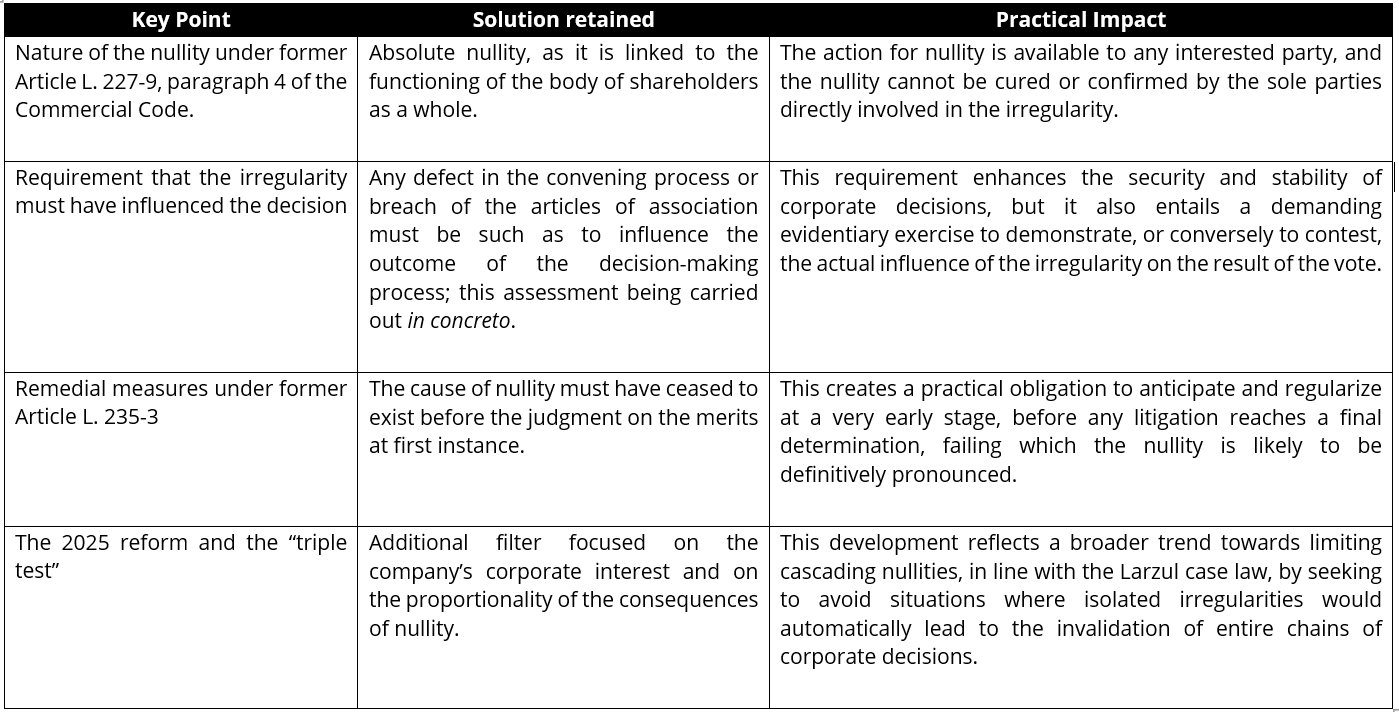
1. Absolute nullity under the former Article L. 227-9, para. 4
Former Article L. 227-9, para. 4 of the Commercial Code allowed the annulment of resolutions taken in violation of the provisions governing collective decisions in SAS companies. The Court had already ruled that this text supplemented the general regime for nullity set out in Article L. 235-1, para. 2 of the Commercial Code.
The Larzul 3 ruling confirms the absolute nature of this nullity: it sanctions the failure to comply with structural rules relating to the functioning of the body of shareholders, which are directly linked to the right to participate in collective decisions (Civil Code, Art. 1844, para. 1).
2. Influence on the decision-making process as a condition for nullity
In Larzul 2, the Court required that the violation of the provisions of the articles of association based on Article L. 227-9, para. 1, be “such as to influence the outcome of the decision-making process”.
This requirement, which had already been applied to the participation of a non-shareholder and to irregularities in the convening of meetings in limited liability companies (SARL), requires, according to the Court of Cassation in its ruling, an analysis in concreto since it overturned the Court of appeal’s ruling on the grounds of lack of legal basis in this respect – the appellate judges should have investigated whether, in a company with only two shareholders in conflict, the failure to convene the minority shareholder to general meetings could have been such as to influence the outcome of the decision-making process.
This assessment is made in particular in light of the distribution of capital, the existence or otherwise of a stable majority bloc, the possibility of a swing in the vote, the role of any debates, and subsequent votes showing that the shareholder who was not convened would in any event have voted in the same way.
Thus, for the Supreme Court, the right to participate in collective decisions is a general principle. An infringement of this right may justify nullity, but the Larzul 3 ruling confirms that, even in such case, annulment is not automatic: the court must verify the concrete impact of the irregularity on the outcome of the vote.
3. Regularisation and former Article L. 235-3: a time limit
Former Article L. 235-3 allowed, in principle, most nullities of corporate resolutions to be covered, with the exception of those based on the unlawfulness of the subject matter.
In this ruling, consistent with the logic of nullities of corporate acts, the Court of Cassation now requires that the cause of nullity must have ceased to exist before the court rules on the merits at first instance in order for regularisation to prevent annulment. Regularisation on appeal is therefore ineffective.
In practice, this means that any defects in the notice of meeting or in compliance with the articles of association must be dealt with without delay, otherwise actions for nullity may be brought for three years (Civil Code, Art. 1844-14; Commercial Code, Art. L. 235-9).
4. Coordination with the new regime resulting from the Ordinance of 12 March 2025
As from 1 October 2025, the reform of nullity in company law will introduce a “triple test” in Article 1844-12-1 of the Civil Code: the judge may annul the decision only after assessing, in particular, whether the consequences for the company’s interests are not disproportionate in light of the alleged infringement.
The logic of a concrete assessment of the impact of the irregularity, already at work in Larzul 2 and confirmed by Larzul 3, therefore seems to foreshadow this new filter, even though it applied under the former provisions of L. 227-9 and L. 235-3 of the Commercial Code.
Summary table